
The Cheapest and Most Expensive Cars to Insure in Florida
The car you choose can quadruple your insurance bill. We show the cheapest and most expensive vehicles to insure, with cited 2025 numbers, why the gap is so wide, and how much extra Florida drivers pay on top.

Eddie Ezekiel
Published Sep 16, 2026 · 4 min read
Updated Sep 16, 2026

Image credit: Photo by Renato Rocca on Pexels
Before you buy a car, it is worth knowing that the model you pick can quadruple your insurance bill. Two drivers with identical records, ZIP codes, and credit can pay wildly different premiums simply because one drives a family SUV and the other a performance sedan. In Florida, already the most expensive state to insure a car, that vehicle gap sits on top of an already-high baseline. Below, we show the cheapest and most expensive cars to insure with cited 2025 numbers, explain why the spread is so wide, and quantify the extra Florida drivers pay.
What makes a car cheap or expensive to insure
Insurers price the car as carefully as they price the driver. A handful of vehicle traits do most of the work:
- Value and repair cost. A pricier car, or one with expensive parts and few certified shops, costs more to fix or replace.
- Horsepower. Fast cars get driven fast and crash harder, so performance models carry a premium.
- Theft rate. Frequently stolen models cost more on the comprehensive side.
- Safety features. Strong crash ratings and driver aids lower injury claims and the premium.
- Repair complexity. EVs and tech-heavy cars can be totaled after modest damage, raising rates.
The cheapest cars to insure
The bargain end of the list is dominated by practical family vehicles: crossovers, small SUVs, and minivans with strong safety scores and modest repair costs. Per CarEdge's 2025 data, the cheapest to insure cluster right around $1,900 a year on U.S. averages: the Mazda CX-5 ($1,912), Honda CR-V ($1,916), Hyundai Kona ($1,925), Subaru Outback ($1,929), and Subaru Crosstrek ($1,933). For sedans, the Honda Civic and Toyota Camry round out the cheap end.
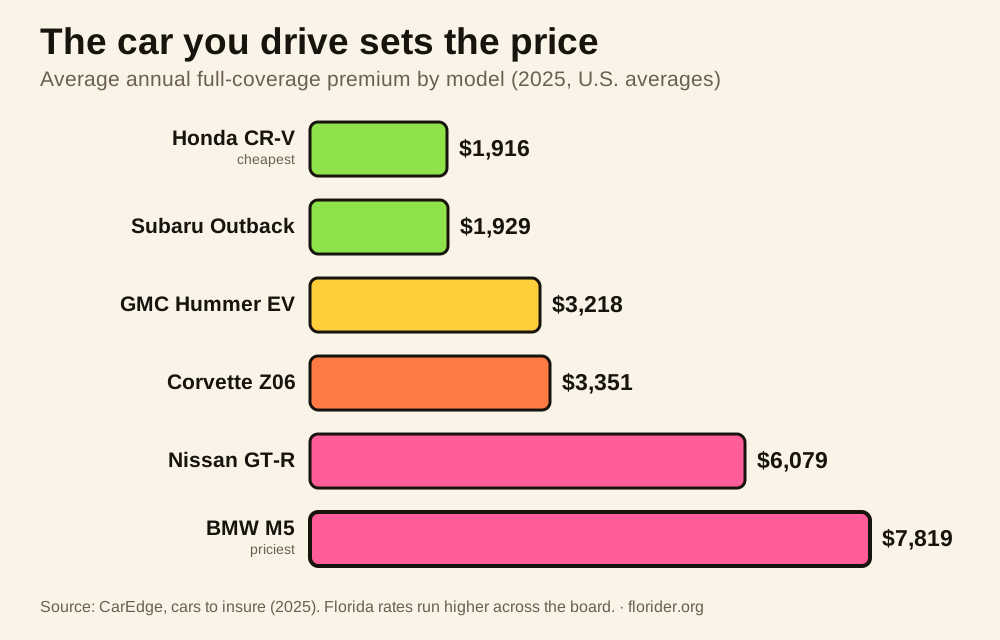
Image credit: FloRider, data from CarEdge (2025)
The most expensive cars to insure
At the top of the range sit high-performance and luxury cars, plus some heavy-duty trucks and EVs. Per CarEdge, the BMW M5 averages about $7,819 a year, the Audi RS 7 around $7,065, and the Nissan GT-R $6,079. The Chevrolet Corvette Z06 ($3,351), GMC Hummer EV ($3,218), and Ford F-450 ($3,179) also rank near the top. The common thread is expensive repairs, high horsepower, and a driver profile that files more and costlier claims.
The Florida markup
Because Florida sits at or near the top of every state ranking, treat the national numbers as a floor, not a target. Whatever a model costs to insure nationally, a Florida quote will typically land well above it, driven by the same forces that make the whole state expensive: uninsured drivers, hurricanes, dense traffic, and litigation. The relative order still holds, though: a cheap-to-insure CR-V is cheap in Florida too, and an M5 is punishing everywhere, just more so here.
How to use this when buying a car
- Quote the specific car before you buy. The difference between two vehicles can be thousands of dollars a year, so get an insurance quote as part of the shopping process.
- Favor high-safety family models if you want the lowest premium: crossovers and small SUVs dominate the cheap list.
- Think twice about performance and luxury. Horsepower and price tags both raise the rate, sometimes more than the car payment difference.
- Factor in EV insurance. Electric vehicles can cost more to insure due to battery repair costs, so quote them specifically.
- Shop several insurers, since each one prices the same car differently.
Frequently asked questions
What is the cheapest type of car to insure?
What cars are most expensive to insure?
How much does the car affect my insurance?
Will these prices be higher in Florida?
The car in your driveway is one of the biggest levers on your insurance bill, and unlike your age or ZIP code, it is entirely your choice. Family SUVs and crossovers keep premiums low; sports cars, luxury sedans, and some EVs push them to four times as high. In Florida, where every rate runs above the national average, choosing a cheap-to-insure model is one of the simplest ways to keep the most expensive state a little more affordable. Quote the car before you buy it, and let the premium be part of the decision.
Last updated: Sep 16, 2026
We cite Florida statutes, the FLHSMV, and industry bodies like the Insurance Information Institute. How we research and maintain these guides. Spotted an error? Tell us.
About the author
Eddie Ezekiel
Eddie Ezekiel is a product and data specialist who builds digital tools for the insurance industry, including the website of Golden Eagle, an established insurance and financial-services firm. He founded FloRider to translate Florida's confusing car-insurance rules into plain English, with every claim traced back to primary sources like the FLHSMV.
Related reads

The 5-Year True Cost of Owning a Car in Florida
A car costs far more than its sticker price. Over five years in Florida, insurance is nearly the single biggest cost of ownership, rivaling depreciation. We break down where the money actually goes, and the one big cost you can actually cut.

The Real Cost of Driving Uninsured in Florida
Skipping car insurance in Florida to save money is a trap. Getting caught suspends your license and triggers an expensive FR-44; crashing uninsured adds personal liability and a lawsuit. We add up what it really costs, both ways.

What Your Credit Score Costs You on Florida Car Insurance
In Florida, credit can swing your car insurance more than almost anything else. A poor-credit driver pays about 138% more than one with excellent credit. We show the real numbers, why insurers do it, and how to lower your rate.