
How Much a Ticket, Accident, or DUI Raises Your Florida Rate
One violation can raise your Florida premium for years. Using cited data, we show what a speeding ticket, an at-fault accident, and a DUI actually add, how long each stays on your rate, and how to bring the bill back down.

Eddie Ezekiel
Published Aug 26, 2026 · 5 min read
Updated Aug 26, 2026
Image credit: Photo by Kindel Media on Pexels
One bad moment on the road can follow you for years on your insurance bill. In a state that already has some of the highest premiums in the country, a single ticket, at-fault crash, or DUI can add hundreds or even thousands of dollars a year, and it does not reset overnight. Using cited Florida rate data, we show exactly what each common violation adds, how long it sticks to your record, why the same offense costs more at some insurers than others, and the concrete steps that bring your rate back down.
What each violation adds
The chart below shows the average premium increase a Florida driver sees after a single incident, based on Insurance.com rate studies. The pattern is consistent: the more dangerous the behavior, the bigger and longer the surcharge.
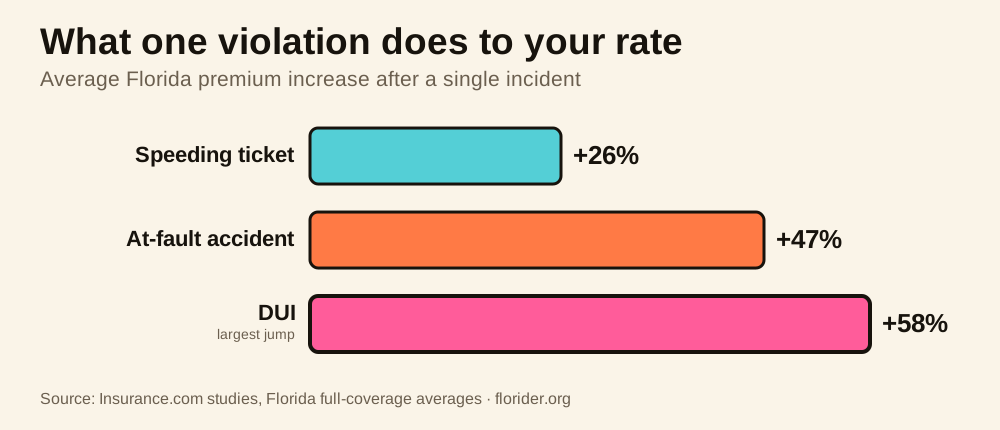
Image credit: FloRider, data from Insurance.com
Speeding ticket: about +26%
A single speeding ticket raises the average Florida premium by roughly 26 percent, and the surcharge typically lasts about three years. How much depends on how fast you were going. A driver cited for 1 to 15 mph over usually sees a smaller bump than one caught at 16 to 29 mph over, and going 30 mph or more over the limit can trigger a much steeper increase, since Florida treats extreme speeding far more seriously.
At-fault accident: about +47%
Causing a crash raises the average Florida premium by about 47 percent, or roughly $1,258 a year in one Insurance.com study. But the range is huge, from about 22 percent to 77 percent, depending on the insurer. That spread is not a rounding error; it means the company that was cheapest for you with a clean record may be far from cheapest once you have an accident on file.
DUI: about +58%, and the biggest jump
A DUI is the single most expensive violation for your insurance. Insurance.com data shows the average Florida full-coverage premium rising from about $3,451 to $5,457 after a DUI, a jump of roughly 58 percent, more than a speeding ticket or even an at-fault accident. On top of the premium, a DUI usually forces you to file an FR-44 in Florida, which requires far higher liability limits than a standard SR-22, and it can keep you in high-risk pricing for years.
How long does it stay on your rate?
The good news is that surcharges are temporary. As long as you avoid new incidents, your rate drifts back toward normal over a few years:
| Violation | Typical surcharge | About how long it lasts |
|---|---|---|
| Speeding ticket | ~26% | ~3 years |
| At-fault accident | ~47% (range 22% to 77%) | 3 to 5 years |
| DUI | ~58% | 5 years or more, plus FR-44 |
Why the same violation costs more at some insurers
The 22-to-77-percent range on an at-fault accident is the key insight. Every insurer prices risk with its own formula, so one company might shrug off a first ticket while another hits it hard. That is why loyalty is expensive after a violation: the insurer that treated you well with a clean record may punish the same offense far more than a competitor would. The only way to find out is to re-quote several companies with the violation on your record.
How to bring your rate back down
- Re-shop several insurers with the violation on your record, since the surcharge varies enormously by company.
- Take an approved defensive-driving course, which can reduce points and, for some drivers, lower the premium.
- Wait it out cleanly. Most surcharges fade after three to five incident-free years.
- Consider telematics, which lets you rebuild a safe-driving record and earn a discount.
- Raise your deductible to offset part of the higher premium if you can cover it.
- Look at high-risk specialists if mainstream insurers quote sky-high after a DUI; some carriers price these situations better.
Frequently asked questions
How much does a speeding ticket raise insurance in Florida?
How much does an at-fault accident raise my rate?
How much does a DUI increase car insurance in Florida?
How long do violations affect my insurance?
A ticket, an accident, or a DUI all raise your Florida premium, but by very different amounts and for different lengths of time. You cannot erase a violation, yet you have real control over what it costs: re-shop the market, take a defensive-driving course, lean on telematics, and let the clock run clean. In Florida's expensive market, the driver who acts after a violation, rather than accepting the first renewal notice, is the one who pays far less to recover.
Last updated: Aug 26, 2026
Sources & references
We cite Florida statutes, the FLHSMV, and industry bodies like the Insurance Information Institute. How we research and maintain these guides. Spotted an error? Tell us.
About the author
Eddie Ezekiel
Eddie Ezekiel is a product and data specialist who builds digital tools for the insurance industry, including the website of Golden Eagle, an established insurance and financial-services firm. He founded FloRider to translate Florida's confusing car-insurance rules into plain English, with every claim traced back to primary sources like the FLHSMV.
Related reads

The 5-Year True Cost of Owning a Car in Florida
A car costs far more than its sticker price. Over five years in Florida, insurance is nearly the single biggest cost of ownership, rivaling depreciation. We break down where the money actually goes, and the one big cost you can actually cut.

The Cheapest and Most Expensive Cars to Insure in Florida
The car you choose can quadruple your insurance bill. We show the cheapest and most expensive vehicles to insure, with cited 2025 numbers, why the gap is so wide, and how much extra Florida drivers pay on top.
The Real Cost of Driving Uninsured in Florida
Skipping car insurance in Florida to save money is a trap. Getting caught suspends your license and triggers an expensive FR-44; crashing uninsured adds personal liability and a lawsuit. We add up what it really costs, both ways.