Florida Insurance Basics
Car Insurance Coverage in Florida, Every Type Explained
Florida's required coverage is a floor, not a full policy. A plain-English walk through every car insurance coverage type, from PIP and liability to full coverage and the add-ons, with how much of each to actually carry.

Eddie Ezekiel
Nov 7, 2026 · 6 Min Read · Updated Nov 7, 2026

Image Credit · Photo by Vlad Deep on Pexels
On This Page
Florida's car insurance law builds you a floor and then walks off the job. It makes you buy just enough to register a car, and not one dollar more of the coverage that would actually protect you in a bad crash. So the policy the state hands you is not the policy you want. The difference between the two is the whole game, and it comes down to a short stack of coverages, each one doing a single job.
The Floor Florida Pours for You
To put a car on the road in Florida, you need two things. Ten thousand dollars of Personal Injury Protection, or PIP, which pays your own medical bills after a crash no matter who caused it. And ten thousand dollars of Property Damage Liability, which pays for the other person's car or mailbox or storefront when you are at fault. That is the entire legal requirement, per the FLHSMV. What stands out is what is missing. Florida does not make you carry a cent of coverage for the injuries you cause other people. That gap is the whole subject of what car insurance is required in Florida, and how PIP pays out is covered in Florida no-fault and PIP.
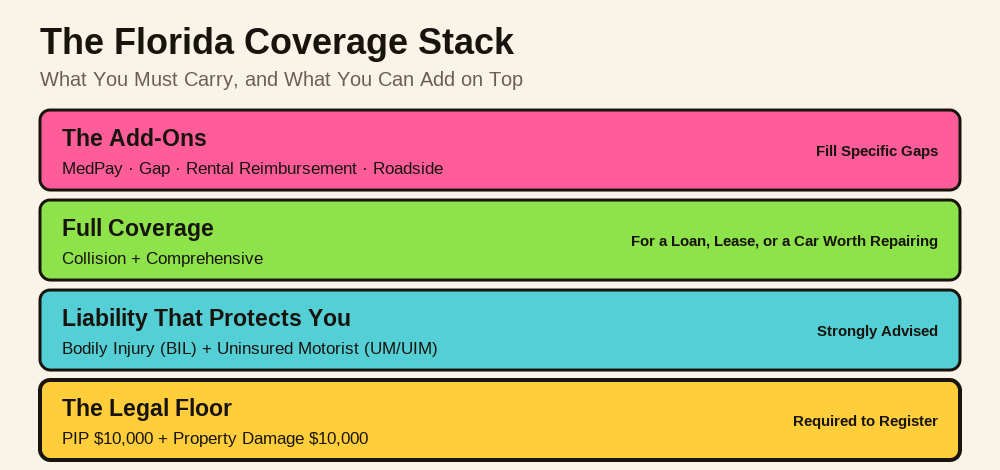
Image Credit · FloRider
Liability, the Coverage That Protects Everyone but You
Liability is the part of a policy that looks outward. Bodily Injury Liability, or BIL, pays for the injuries you cause when a crash is your fault, the hospital bills and lost wages of the people in the other car. Florida is one of the few states that does not require it. Skip it, and an at-fault crash becomes a personal debt, with the average bodily-injury claim running about $26,501. The full case for carrying it is in does Florida require bodily injury coverage.
Uninsured Motorist coverage, or UM, flips the risk around. It pays for your own injuries when the driver who hits you has no insurance, or not enough of it. In a state where about one in five drivers carries nothing, that is not a rare event, as the data on Florida's uninsured drivers makes clear. Your PIP covers a sliver of your costs, but a serious injury blows past $10,000 fast, and UM is what catches you when it does.
Full Coverage, the Part That Pays for Your Own Car
Full coverage is a phrase every agent uses and no statute defines. It is shorthand for adding two coverages that protect your own car, on top of the liability that protects everyone else. Collision pays to repair or replace your car after a crash, whoever caused it. Comprehensive handles the rest, theft, fire, flood, a storm, a tree limb, the hurricane that is always somewhere off the coast. Neither one is required by law. Both are usually mandatory if you lease or finance, because the lender owns more of the car than you do. What full coverage really means, and when it stops being worth the premium, is in what full coverage means in Florida.
The Add-Ons Worth Knowing
A handful of smaller add-ons each close one specific gap. MedPay picks up medical costs PIP will not, including the 20% that PIP leaves on the table. Gap insurance covers the difference between what you owe on a loan and what the car is worth the day it is totaled. It matters most on a new car that loses value fast. Rental reimbursement keeps you mobile while your car is in the shop, and roadside assistance handles the tow and the dead battery. None of these is essential, but one or two often earns its keep. Whether gap is one of them is laid out in what gap insurance is and whether Floridians need it. If your car is modified, whether those parts are covered is worth checking before you assume they are.
How Much of Each Should You Carry
So why not carry the minimum and just drive carefully? Because the minimum is not built around your risk. It is built around the lowest number the state could defend politically. A careful driver still gets hit by a careless one, and a single serious injury can run into six figures. The limits that actually protect a household with a job and some savings look nothing like the floor.
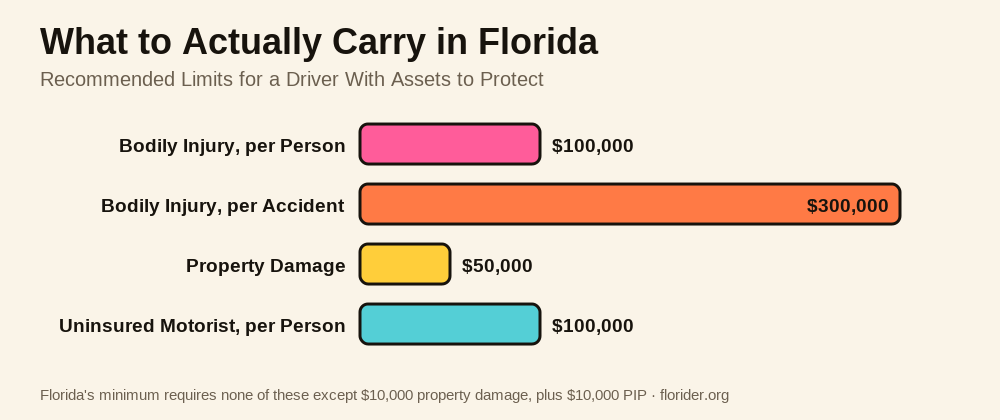
Image Credit · FloRider
For most Florida drivers with something to lose, a solid policy carries bodily injury around 100/300, property damage near $50,000, and uninsured motorist to match. Those numbers cost far less than people expect. The jump from a $10,000 limit to a $100,000 one is cheap once the base premium is paid, because the first dollar of coverage is the expensive one.
| Coverage | What It Pays For | Required in Florida |
|---|---|---|
| Personal Injury Protection (PIP) | Your own medical bills after a crash, 80% up to the limit, no matter who is at fault | Yes, $10,000 |
| Property Damage Liability (PDL) | Damage you cause to someone else's car or property | Yes, $10,000 |
| Bodily Injury Liability (BIL) | Injuries you cause to other people | No |
| Uninsured / Underinsured Motorist (UM/UIM) | Your injuries when an uninsured driver hits you | No |
| Collision | Repairs to your own car after a crash, whoever is at fault | No |
| Comprehensive | Your car against theft, fire, flood, storms, and falling objects | No |
| MedPay | Medical costs PIP does not, including the other 20% | No |
| Gap | The difference between what you owe and what the car is worth | No |
| Rental Reimbursement | A rental car while yours is in the shop | No |
| Roadside Assistance | Towing, a jump-start, a flat, a lockout | No |
How to See What You Already Have
You do not have to guess at any of this. Every coverage you carry, and every one you skipped, is listed on your declarations page, the one-sheet summary at the front of your policy. Reading it takes about five minutes once you know what the abbreviations stand for, which is the entire job of how to read your Florida declarations page.
Frequently Asked Questions
What Car Insurance Coverage Is Required in Florida?
What Does Full Coverage Mean in Florida?
Do I Need Uninsured Motorist Coverage in Florida?
What Is the Difference Between Collision and Comprehensive?
How Much Car Insurance Coverage Should I Carry in Florida?
Is Auto Insurance Coverage the Same as Car Insurance Coverage?
The mistake is to treat car insurance as a box the state makes you tick. Florida's floor exists to keep the registration line moving, not to protect you, and it quietly assumes you will cause no harm and come to none. Coverage is really a set of small bets about what you stand to lose, your health and whatever you have managed to save. Build the policy around those, not around the law. For how the whole policy fits together, start with our complete Florida car insurance guide.
Last Updated · Nov 7, 2026
Sources & References
- FLHSMV
- what car insurance is required in Florida
- Florida no-fault and PIP
- does Florida require bodily injury coverage
- data on Florida's uninsured drivers
- what full coverage means in Florida
- what gap insurance is and whether Floridians need it
- whether those parts are covered
- how to read your Florida declarations page
- complete Florida car insurance guide
We cite Florida statutes, the FLHSMV, and industry bodies like the Insurance Information Institute. How we research and maintain these guides. Spotted an error? Tell us.
About the Author
Eddie Ezekiel
Eddie Ezekiel is a product and data specialist who builds digital tools for the insurance industry, including the website of Golden Eagle, an established insurance and financial-services firm. He founded FloRider to translate Florida's confusing car-insurance rules into plain English, with every claim traced back to primary sources like the FLHSMV.
Keep Reading